How to Use
WEDA Core Installation
This guide covers the process of downloading, installing, and initializing WEDA Core using the OpsManager installer.
Prerequisites
Before installing WEDA Core, ensure your environment meets the basic system and networking requirements.
- Operating System: A supported Linux distribution (e.g., Ubuntu 24.04 LTS).
- Permissions: sudo
/ rootaccess for system-wide installations. - Networking: Internet access for downloading dependencies (if using the online installer).
1. Download OpsManager Installer
Download the OpsManager installer package (.run file).
Replace <version> with the actual version number, e.g., v0.1.0.
wget https://downloads.opsmanager.edgesync.ws/releases/opsmanager-installer-<version>.run
2. Set Executable Permissions
After downloading, make the installer executable:
chmod +x opsmanager-installer-<version>.run
3. Remove Previous Installation (Optional)
If you have an existing installation, clean up previous OpsManager installations if necessary:
opsmanager destroy --purge
rm -rf ~/.opsmanager
4. Run the Installer
Execute the installer with sudo privileges. The installer will perform automated checks and set up the environment.
sudo ./opsmanager-installer-<version>.run
5. Define the Initial Configuration
Once installation is complete, run the interactive setup wizard to creating the initial configuration file.
opsmanager new
-
Configuration Details:
In the initial setup of OpsManager, you will be prompted for Host IP, Domain Name, and Distro User.
Press Enter to accept the default values, or enter your deployment specifics.
After confirming, the configuration is saved to the~/.opsman/config.ymlfile.
Parameter Description Host IPThe IP address where WEDA Core will be deployed. Domain NameThe domain name used to access the WEDA Core services. Distro UserThe system user executing OpsManager.
6. Deploy WEDA Core Platform
Execute the deployment command. OpsManager will read the configuration and use Ansible to automatically deploy all necessary services.
opsmanager up
The deployment involves pulling container images and configuring services. This process may take several minutes.
Access WEDA Desk
This section describes how to access WEDA Desk, reset the admin password, and create a Tenant Admin user.
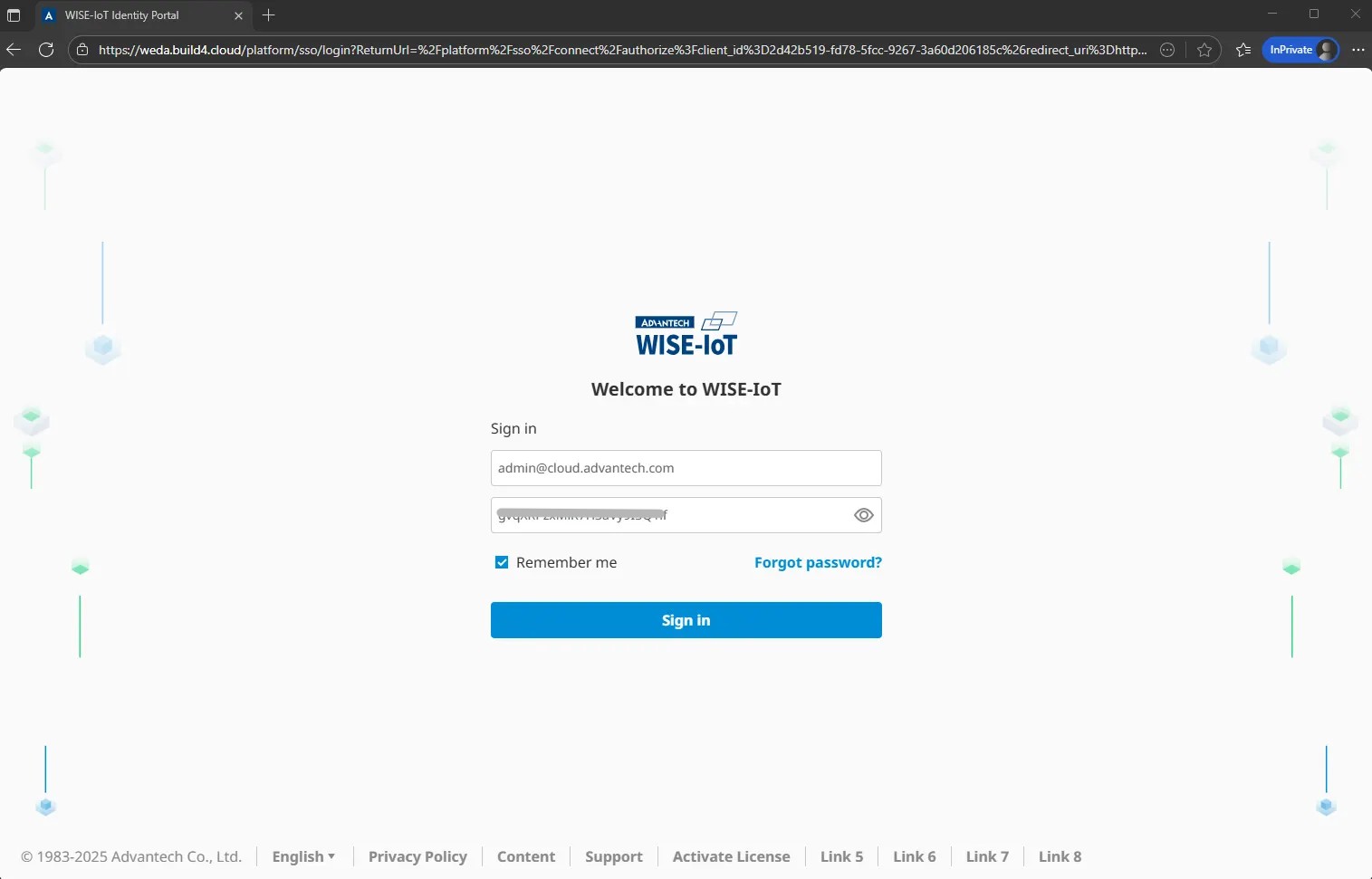
1. Sign in WEDA Desk
Open a web browser and go to the Desk: https://<domain>/platform/desk. Replace <domain> with the actual domain.
You will be automatically redirected to the correct login page.
Log in with the default SSO credentials.
2. Reset Admin Password
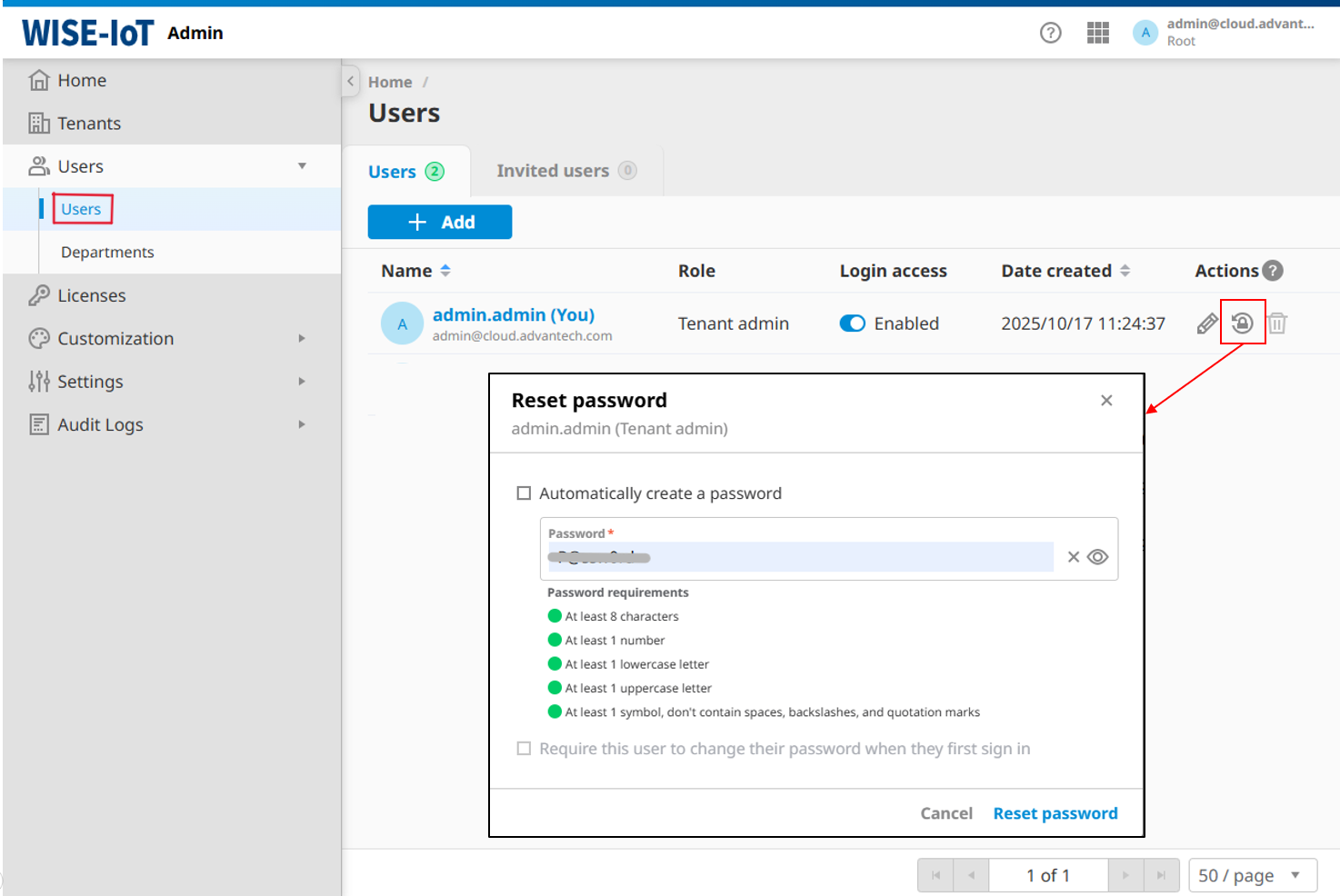
Go to User in the left menu, find admin@cloud.advantech.com, and reset the password.
3. Add a Local User
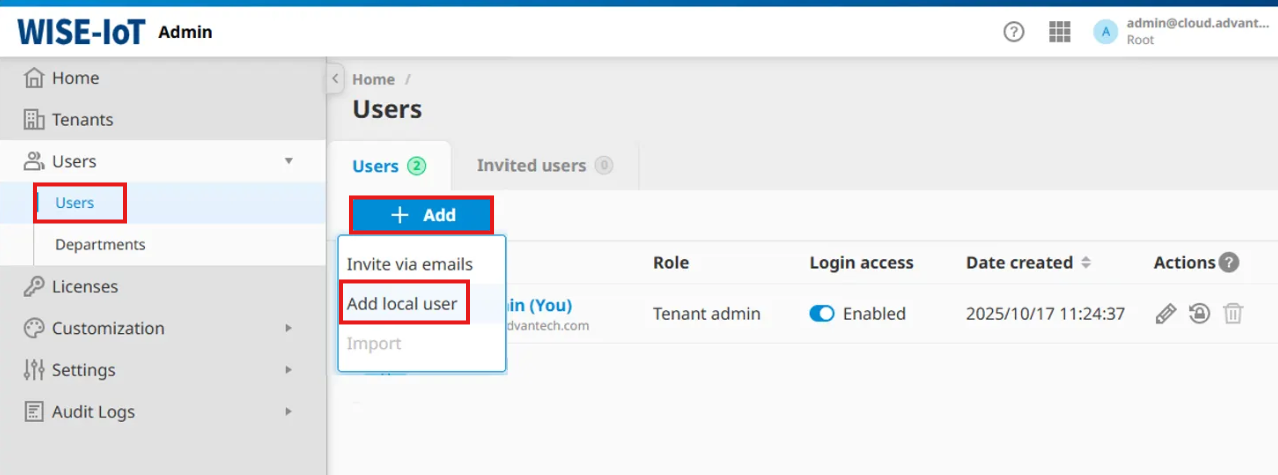
Click + Add button to create a new User.
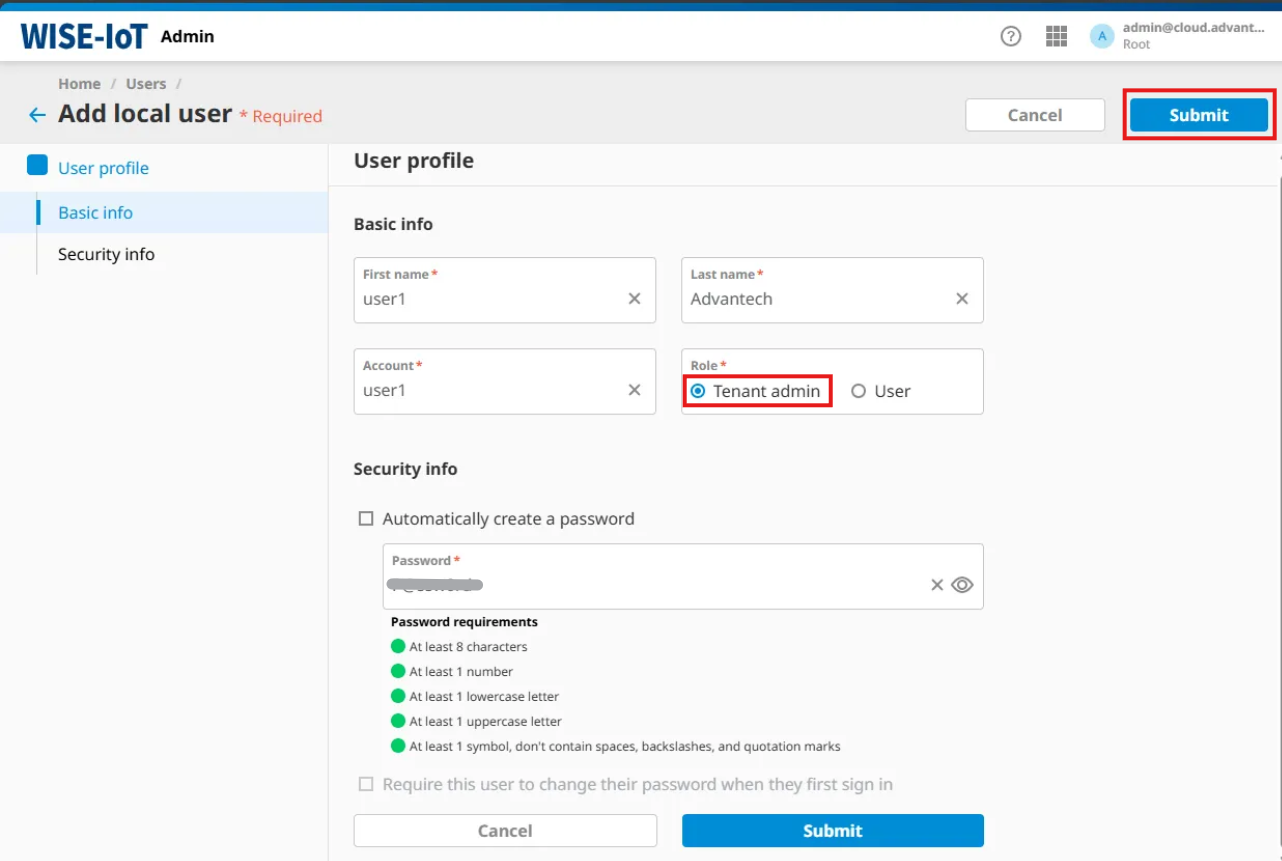
Fill in the user details and choose Tenant Admin as the role.
- First name
- Last name
- Account name
- Your own password
Click Submit.
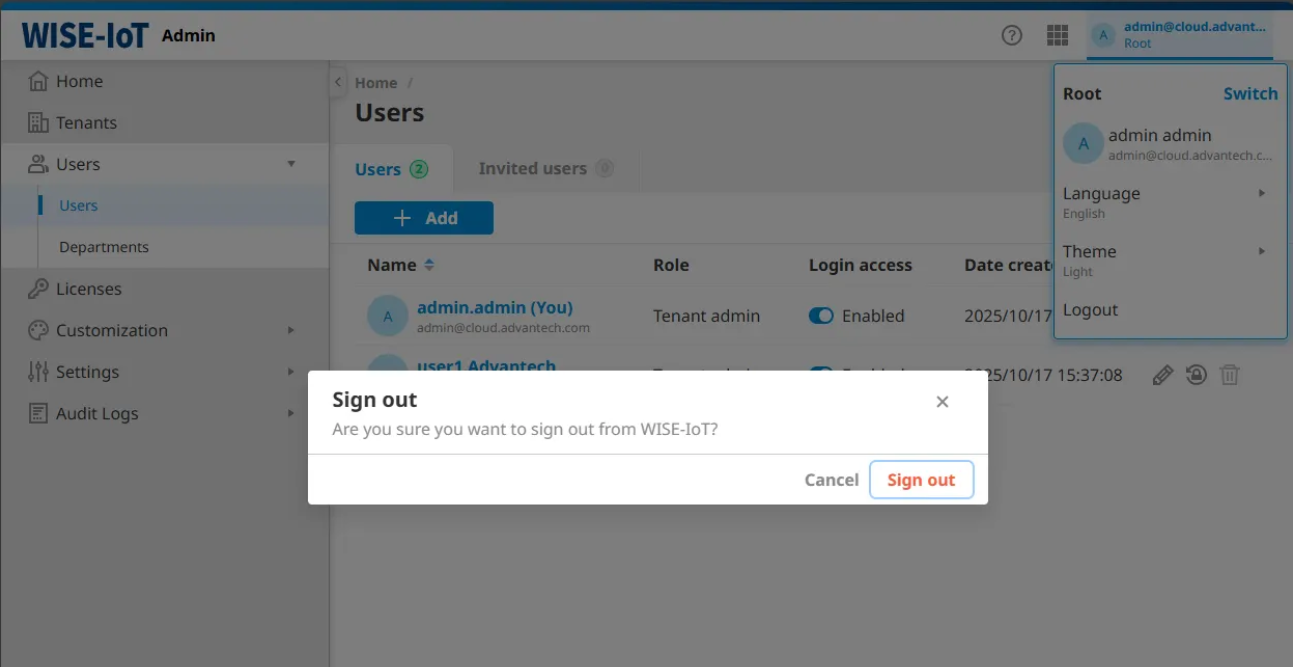
5. Sign Out
Click your username in the top-right corner and select Sign Out.

Register a Device on WEDA Core
This section describes how to register a device in WEDA Core using APIs. You will retrieve user tokens, create an organization, refresh your access token, and prepare for device onboarding.
Prerequisites
Before you begin, please ensure your environment meets the following requirements:
- API Tool: Postman or an any REST API client.
- Edge Device: A prepared hardware device (e.g., an Advantech MIC-710).
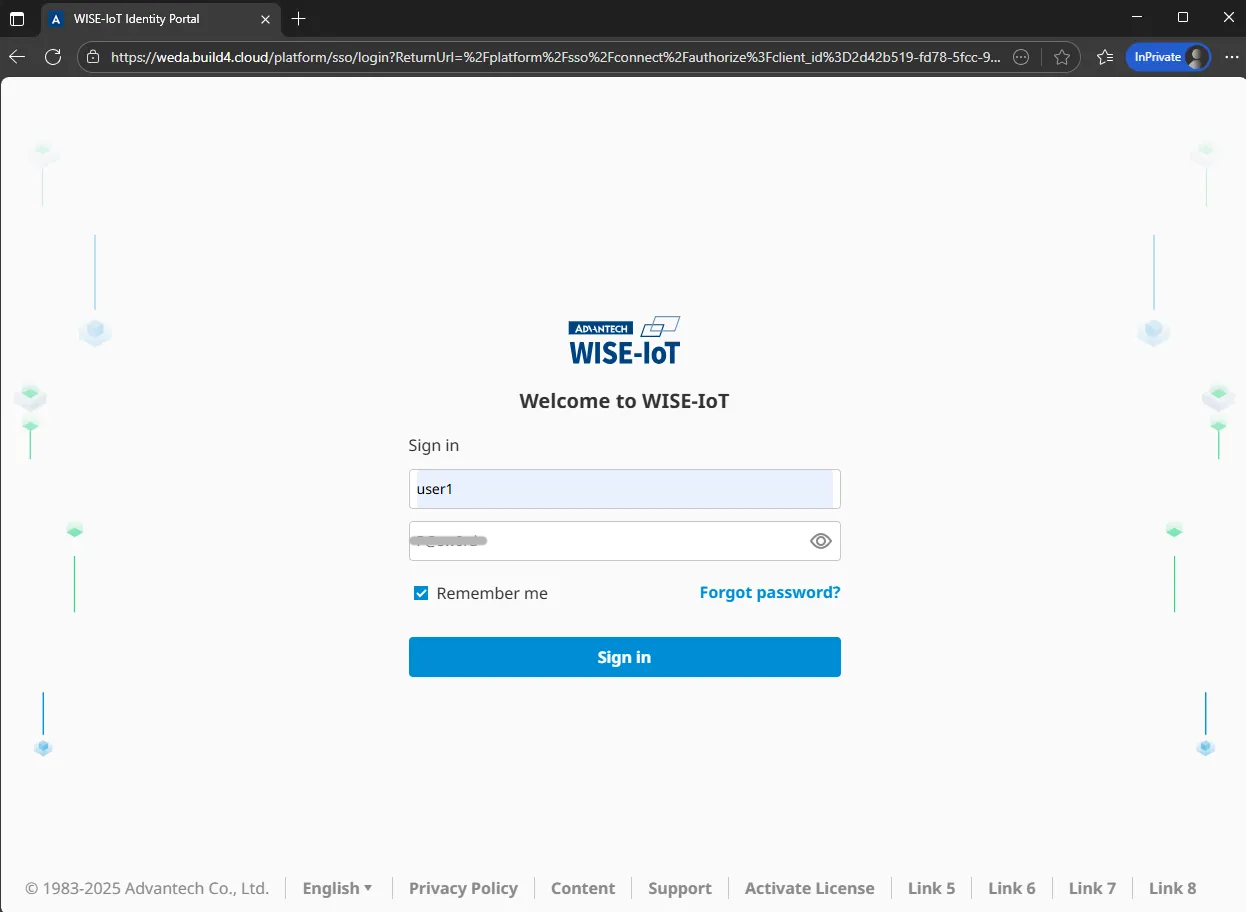
1. Sign in WEDA Desk
Log in WEDA Desk: https://<domain>/platform/desk using the Tenant Admin account.
2. Get User WEDA Core Access Token
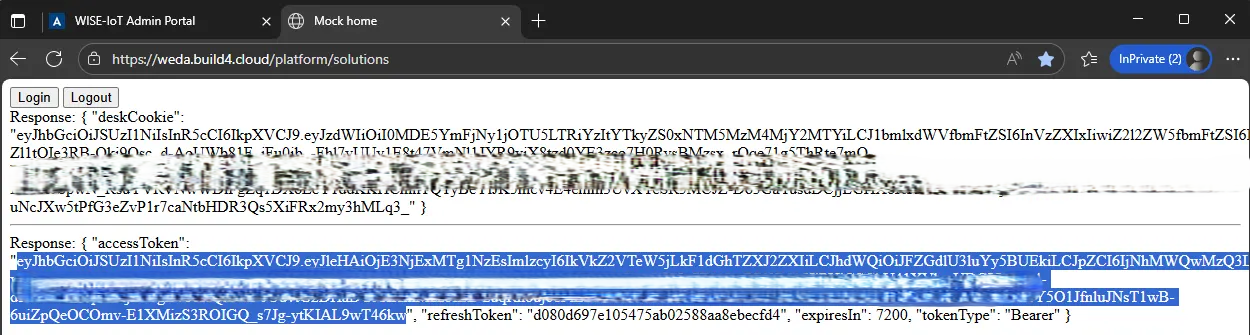
Open a new browser tab and go to: https://<domain>/platform/solutions.
This page will return two types of tokens:
- DeskCookie
- AccessToken - used for WEDA API.
The AccessToken should be included in the Authorization header when calling APIs:
Authorization: Bearer <access-token>
3. Create a New Org
Create a new organization using the following API.
Endpoint
POST /platform/solutions/api/v1/orgs
Example Request
curl --location 'https://<domain>/platform/solutions/api/v1/orgs' \
--header 'Content-Type: application/json' \
--header 'Authorization: Bearer <access-token>' \
--data '{
  "name": "Org1"
}
Example Response
{
  "name": "Org1",
  "id": "3a1d1d06-4759-cefd-af34-0705d0ca8902",
  "parentId": null
}
4. Refresh the accessToken
Refresh the token to obtain an org-scoped accessToken. Use the accessToken and refreshToken retrieved from the previous step in the request body.
Endpoint
POST /platform/solutions/api/v1/auth/tokens
Example Request
curl --location 'https://<domain>/platform/solutions/api/v1/auth/tokens?grant_type=refresh_token' \
--header 'Content-Type: application/json' \
--data '{
  "token": "<access-token>",
  "refreshToken": "<refresh-token>"
}'
The refresh token API does not require an Authorization header.
Example Response
{
    "accessToken": "eyJhbGciOiJSUzI1NiIsInR5cCI6IkpXVCJ9....",
    "refreshToken": "1b5cf6c2587f472fb8b159....",
    "expiresIn": 7200,
    "tokenType": "Bearer"
}
Use the new accessToken for the following API requests.
5. Create a Device
Create a device using the following API, including the Org ID in the request body.
Endpoint
POST /platform/solutions/api/v1/devices
Example Request
curl --location 'https://<domain>/platform/solutions/api/v1/devices' \
--header 'Content-Type: application/json' \
--header 'Authorization: Bearer <access-token>' \
--data '{
  "deviceId": "48b02d8861de",
  "hwModel": "MIC-710",
  "orgId": "3a1d40ed-4f97-aed8-c727-57704d3d5d2e"
}'
- deviceId: Must be a MAC address (lowercase letters and numbers only, no symbols).
- hwModel: The system validates hardware information using
/etc/board. Open the file withvi /etc/boardto check the hardware model. If the file doesn’t exist, create it and enter the hardware model inside.
Example Response
{
    "deviceId": "48b02d8861de",
    "hwModel": "MIC-710",
    "orgId": "3a1d40ed-4f97-aed8-c727-57704d3d5d2e",
    "status": "Registered"
}
The device is now registered on WEDA Core.
WEDA Node Installation
This guide covers the process of installing WEDA Node and activate the edge device.
Prerequisites
Before you begin, please ensure your edge device environment meets the following requirements:
- Docker Engine is installed
- Docker compose is installed
- Permissions: sudo
/ rootaccess for system-wide installations.
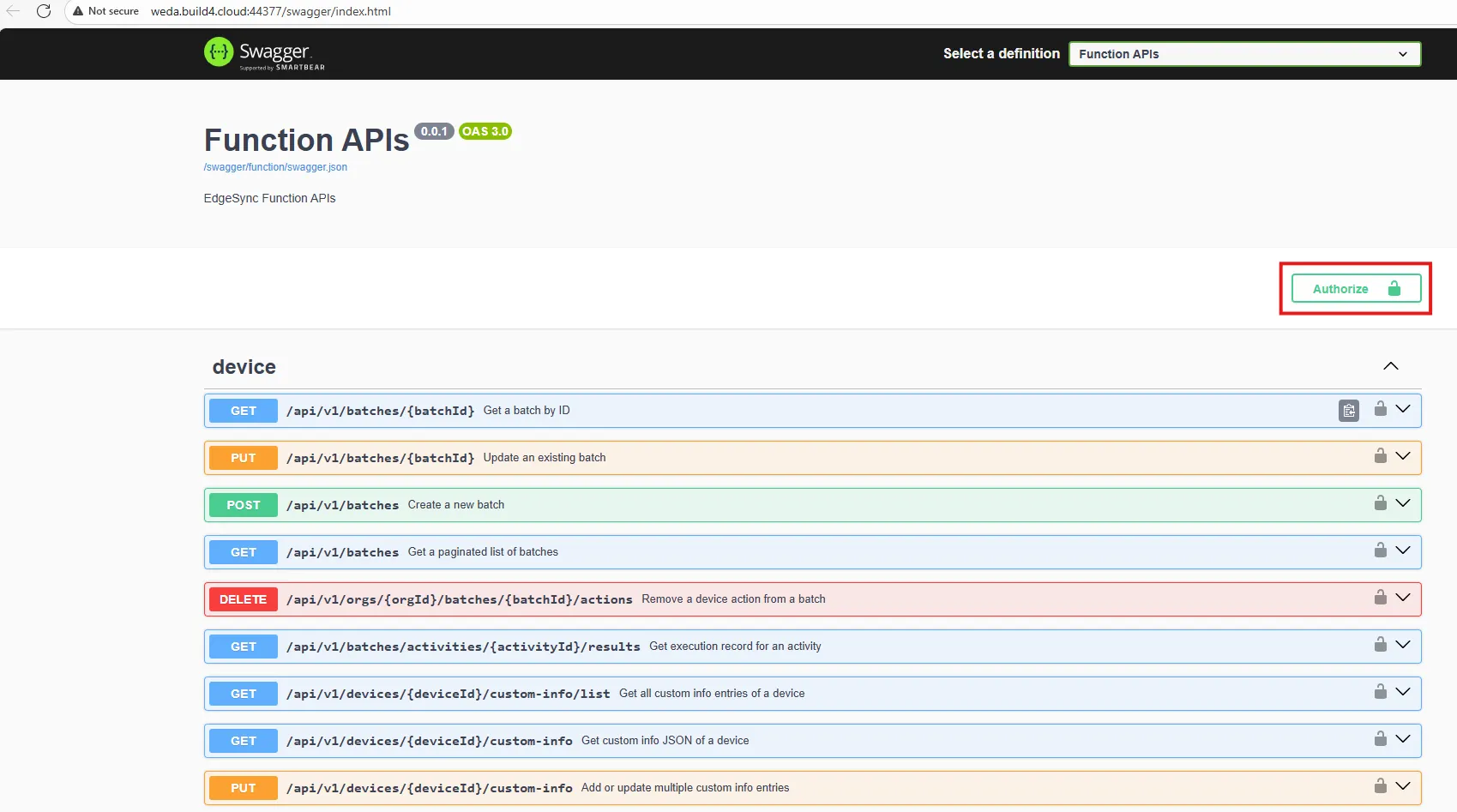
1. Open the Devicemanagement APIs Swagger
Open a web browser and go to the Devicemanagement APIs Swagger: http://<domain>:44377/swagger/index.html.
Authorize the API by entering the accessToken and click Authorize.
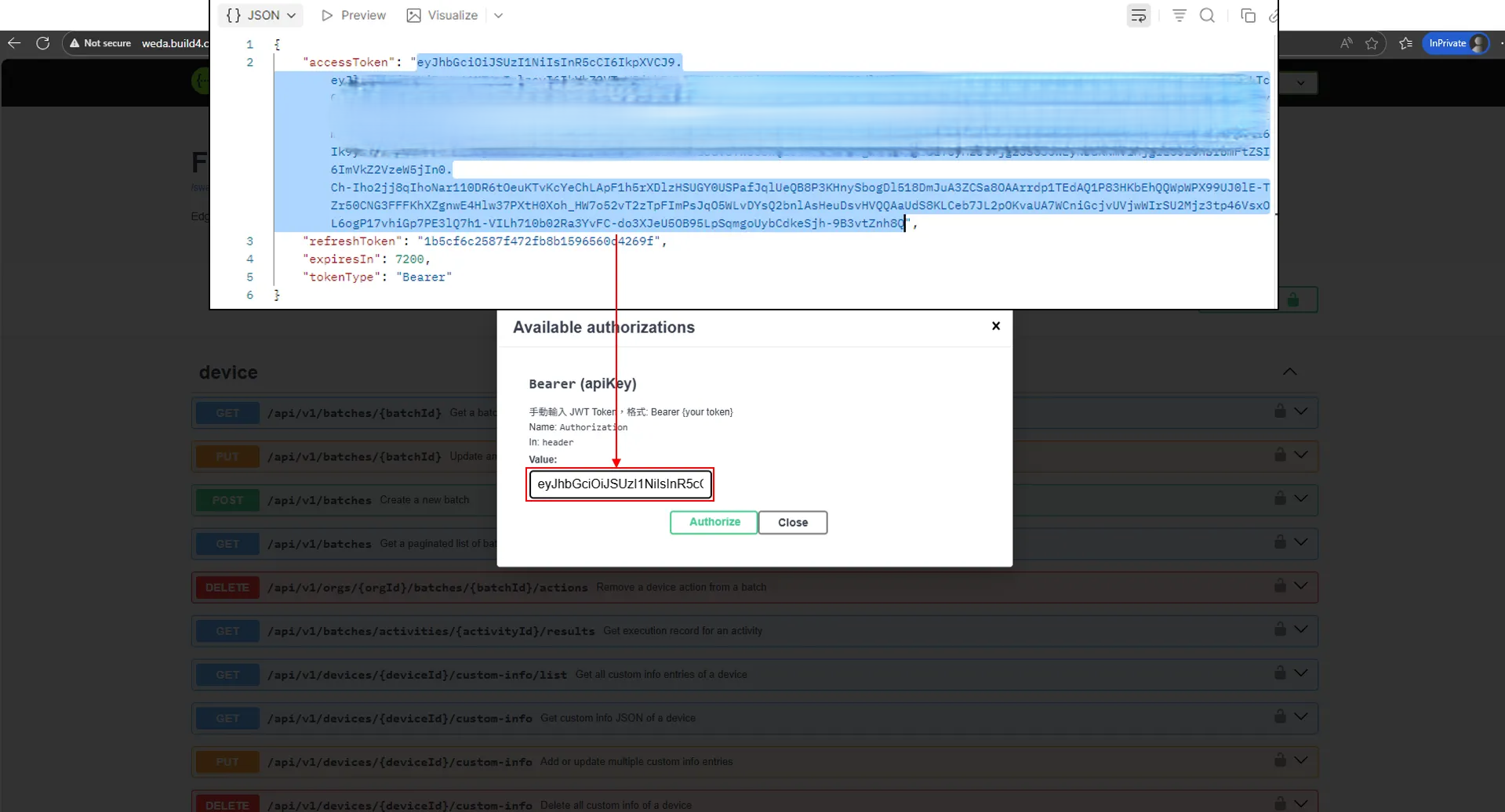
2. Download Device Credential File (Active the Device)
To activate the device, request the WEDA Node credential file (authInfo.json) using the following API.
Endpoint
GET /platform/solutions/api/v1/devices/<deviceId>/auth
The API returns the device authentication details and provides a download link for devie credential file (authInfo).
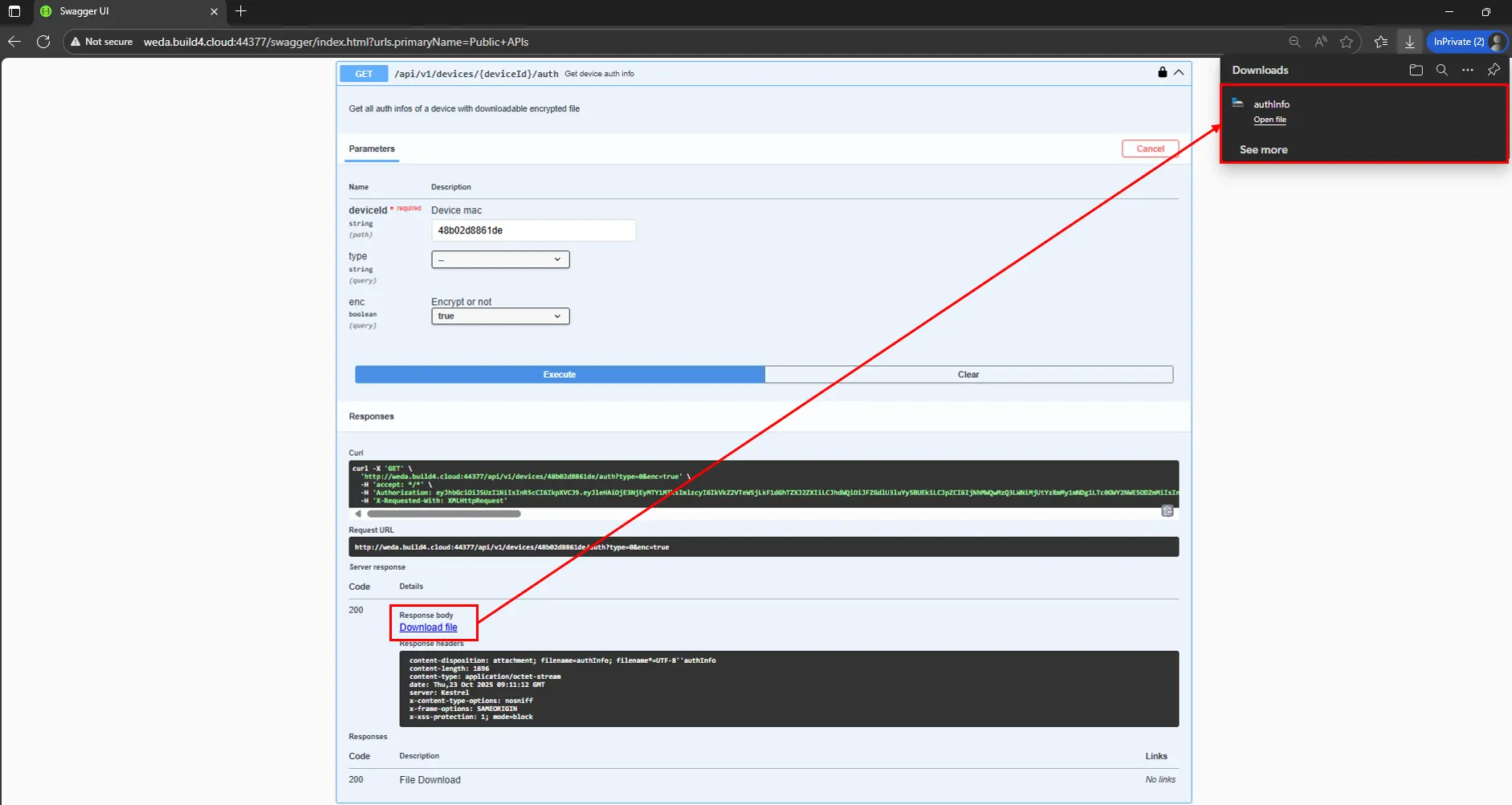
Download the file and save it as authInfo.json.

3. Remove Previous Registration Data (Optional)
If this device was registered previously, remove the old dmagent data before redeploying. This step can be skipped during the first installation.
sudo rm -rf /opt/Advantech/dmagent/data
Stop and clean up existing containers and networks:
docker compose down -v
4. Deploy WEDA Node
Upload the downloaded authInfo.json to the edge device. Follow the installation steps in WEDA Node Documentation.
After deployment, verify the services status:
sudo docker compose ps

You should see both dmagent and data agent services running.
5. Get Device Capabilities
After WEDA Node is deployed, use the following API to check whether the device is successfully online.
Endpoint
GET /platform/solutions/api/v1/devices/<deviceId>/capabilities
Example Request
curl --location 'https://<domain>/platform/solutions/api/v1/devices/48b02d8861de/capabilities' \
--header 'Authorization: Bearer <access-token>'
Example Response
[
    {
        "dtmi": "dtmi:advantech:EdgeSync:NetWorkInfo:networkReceiveErrsTotal;1",
        "name": "rndis0.networkReceiveErrsTotal",
        "resourceId": "774d3d37-90df-5dae-8be1-7ef40f006d72",
        "resourceShortId": "06d72",
        "deviceResourceId": "78c20943-a710-5abb-aa5a-15d5ce845f7d",
        "enabled": false,
        "interval": 0
    },
    {
        "dtmi": "dtmi:advantech:EdgeSync:NetWorkInfo:networkReceiveBytesTotal;1",
        "name": "usb0.networkReceiveBytesTotal",
        "resourceId": "942657ac-6d7f-5a40-9d51-2da27889d063",
        "resourceShortId": "9d063",
        "deviceResourceId": "8a6adb13-b85c-53a9-b666-b702ee3ca5db",
        "enabled": false,
        "interval": 0
    },
    {
        "dtmi": "dtmi:advantech:EdgeSync:SystemInfo:systemTimexOffsetSeconds;1",
        "name": "systemTimexOffsetSeconds",
        "resourceId": "7283ff29-c8ac-541c-b963-d7ec9b7dab71",
        "resourceShortId": "dab71",
        "deviceResourceId": "cc9a9f72-7abb-5291-af20-2475f961c36b",
        "enabled": false,
        "interval": 0
    }
]
If the response includes device capability information, the device is successfully online.
Get Device Sensor Value
This section describes how to enable sensors on the edge device and get telemetry data from WEDA Core.
1. Enable Target Sensors
After obtaining the full list of device capabilities, select resourceId of the sensors that need to upload data to WEDA Core. Use the following API to update the device configuration and enable the selected sensors with the data reporting frequency.
Endpoint
PATCH /platform/solutions/api/v1/devicess/<deviceId>/telemetry-configs/desired
Example Request
curl --location --request PATCH 'https://<domain>/platform/solutions/api/v1/devices/48b02d8861de/telemetry-configs/desired' \
--header 'Content-Type: application/json' \
--header 'Authorization: Bearer <access-token>' \
--data '{
  "allInterval": 2000,
  "sensors": [
    {
      "resourceId": "e1090dee-857c-539d-b572-1e8250113520",
      "enabled": true
    },
    {
      "resourceId": "977f6249-d505-562b-a0af-698981f9710c",
      "enabled": true
    },
    {
      "resourceId": "78f03238-8e21-536d-b445-bcbd8d8b9646",
      "enabled": true
    }
  ]
}'
Example Response
{
    "allInterval": 2000,
    "sensors": [
        {
            "resourceId": "e1090dee-857c-539d-b572-1e8250113520",
            "enabled": true,
            "interval": null
        },
        {
            "resourceId": "977f6249-d505-562b-a0af-698981f9710c",
            "enabled": true,
            "interval": null
        },
        {
            "resourceId": "78f03238-8e21-536d-b445-bcbd8d8b9646",
            "enabled": true,
            "interval": null
        }
    ]
}
2. Get Device Telemetry States
Use the following API to confirm if the configuration have been successfully applied.
Endpoint
GET /platform/solutions/api/v1/devices/<deviceId>/telemetry-configs/reported
Example Request
curl --location --request GET 'https://<domain>/platform/solutions/api/v1/devices/48b02d8861de/telemetry-configs/reported' \
--header 'Content-Type: application/json' \
--header 'Authorization: Bearer <access-token>'
Example Response
{
    "allInterval": 2000,
    "sensors": [
        {
            "resourceId": "e1090dee-857c-539d-b572-1e8250113520",
            "enabled": true,
            "interval": null
        },
        {
            "resourceId": "977f6249-d505-562b-a0af-698981f9710c",
            "enabled": true,
            "interval": null
        },
        {
            "resourceId": "78f03238-8e21-536d-b445-bcbd8d8b9646",
            "enabled": true,
            "interval": null
        }
    ]
}
3. Get Latest Device Telemetry Data
Use the following API to get the latest telemetry snapshot from the device, including online status and the most recent dataObject values.
Endpoint
GET /platform/solutions/api/v1/devices/<deviceID>/inputs/data-objects/latest
Example Request
curl --location --request GET 'https://<domain>/platform/solutions/api/v1/devices/48b02d8861de/inputs/data-objects/latest' \
--header 'Content-Type: application/json' \
--header 'Authorization: Bearer <access-token>'
Example Response
{
    "deviceId": "48b02d8861de",
    "time": "2025-10-30T06:26:26.145Z",
    "dataObjects": {
        "systemTimeSeconds": 170010.165,
        "ramSwapTotalBytes": 3592273920,
        "sdaDiskIOTimeSecondsTotal": 0,
        "mmcblk0DiskWrittenBytesTotal": 6952206336,
        "mmcblk0DiskReadBytesTotal": 2559474688
    },
    "dataTypes": [
        "double",
        "double",
        "double",
        "double",
        "double"
    ]
}
Deploy Container to Device
This section describes how to deploy container applications to the edge device.
1. Prepare a Docker Compose File
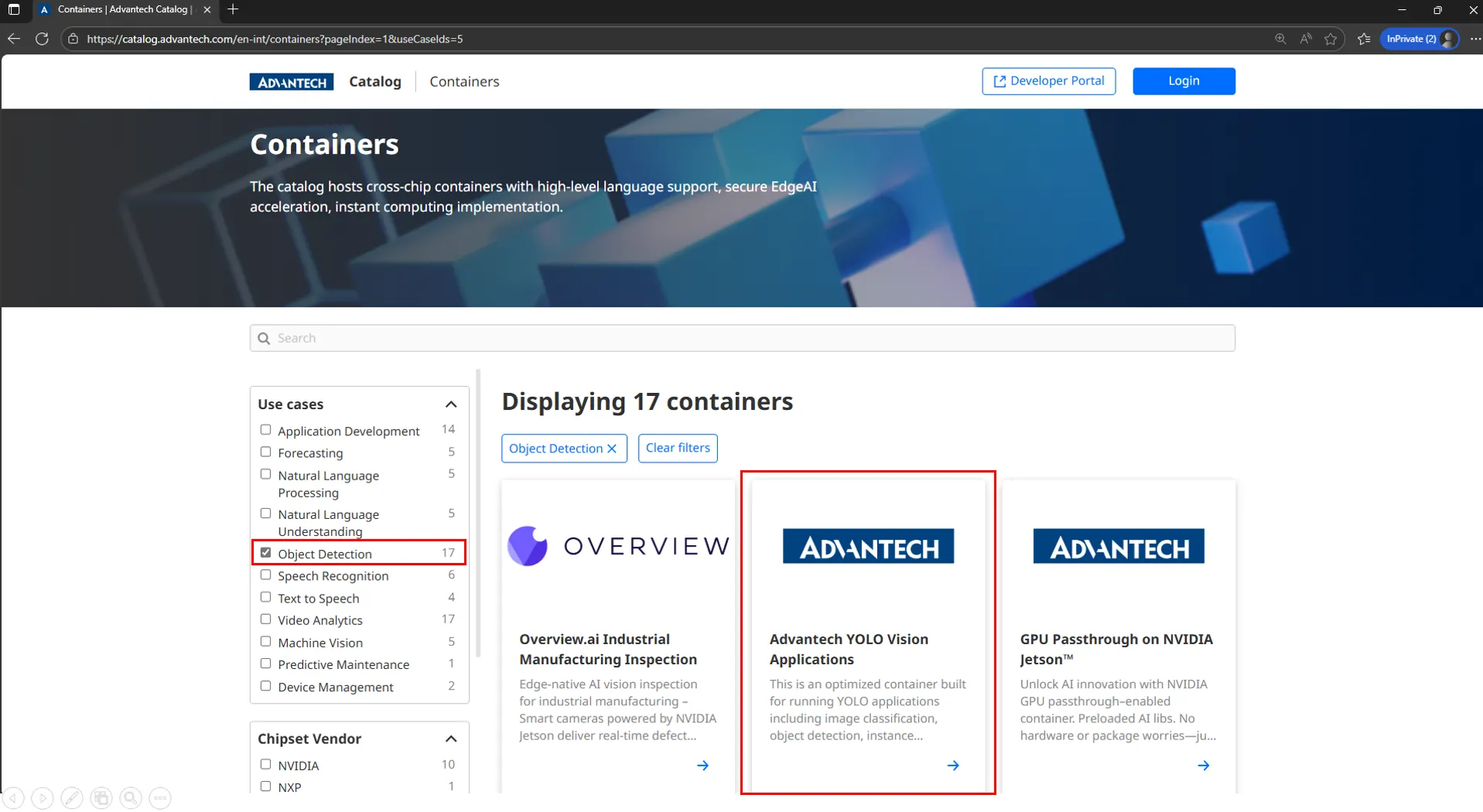
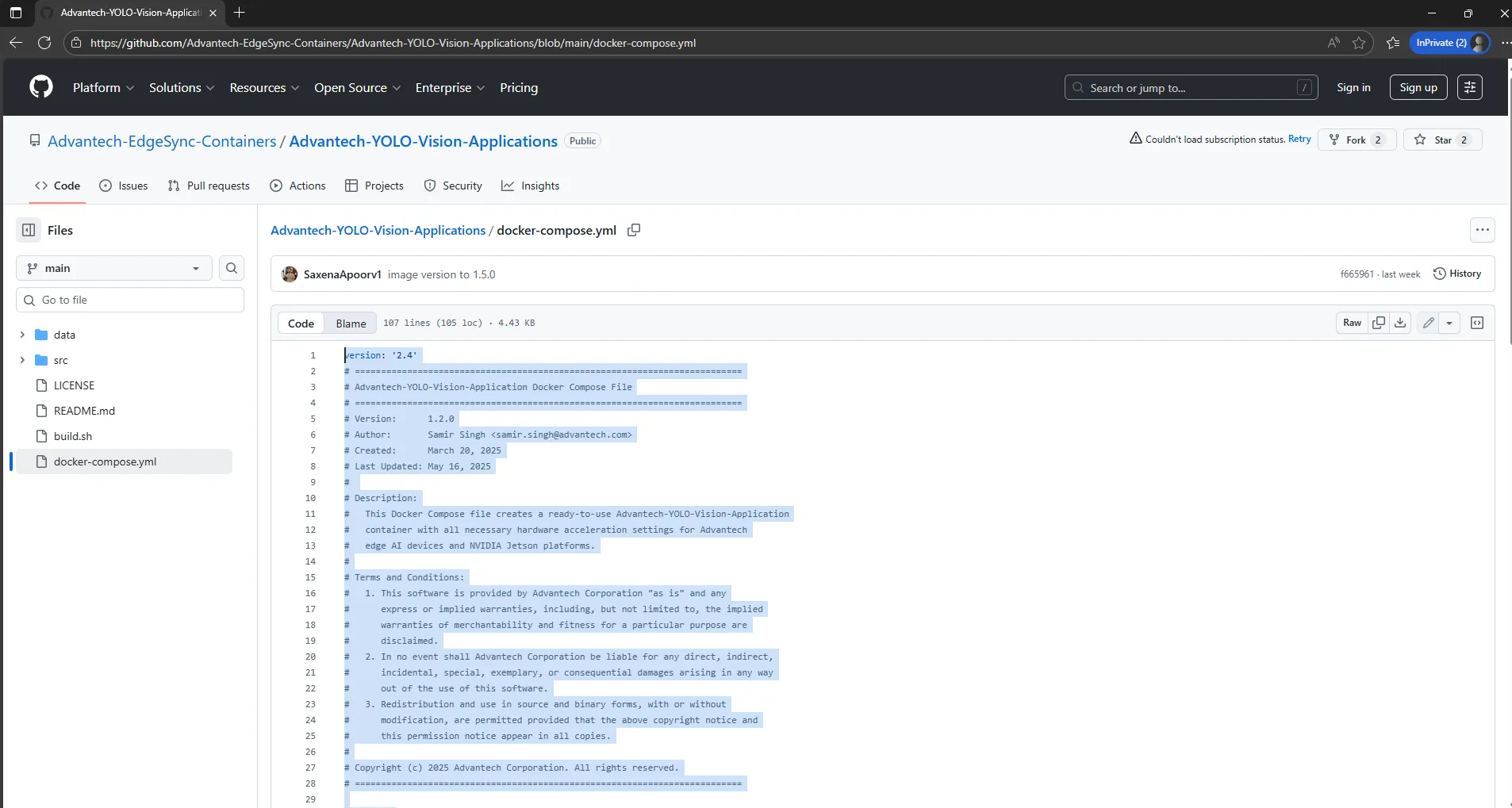
Prepare a docker-compose.yml file, or select a container from the Advantech Catalog which has a GitHub repository link.


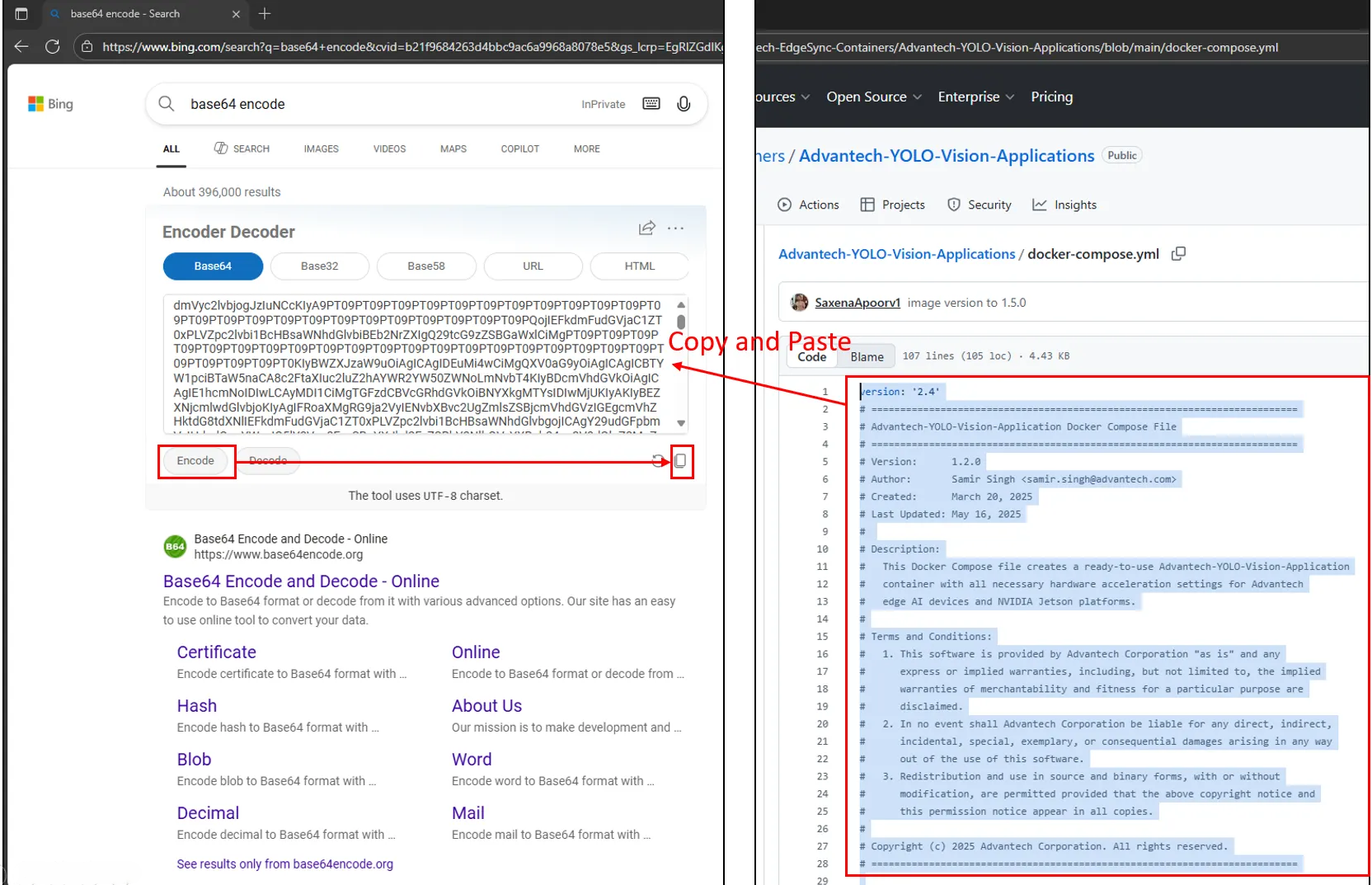
2. Encode the File in Base64
Copy the docker-compose.yml content and encode it in Base64 format. The encoded result will used as composeFileContent in the stack creation API request.
3. Create a Container Stack
Use the following API to create a container stack. Put the Base64-encoded Compose file in composeFileContent. The system will automatically assign a revision number.
Endpoint
POST /platform/solutions/api/v1/orgs/<orgID>/docker-settings/stacks-configs
Example Request
curl --location 'https://<domain>/platform/solutions/api/v1/orgs/3a1d40ed-4f97-aed8-c727-57704d3d5d2e/docker-settings/stacks-configs' \
--header 'Content-Type: application/json' \
--header 'Authorization: Bearer <access-token>' \
--data '{
  "stackName": "stack-name1",
  "type": "compose",
  "composeFileContent": "<Base64-encoded>",
  "environment": {},
  "description": "this is description"
}'
Example Response
{
    "stackConfigId": "e700312d-18e9-4a93-b291-0108596b0a91",
    "stackRevision": "70e1771a-0fd3-4e85-9a17-6ea752f92d0b",
    "stackName": "stack-name1",
    "type": "compose",
    "composeFileContent": "<Base64-encoded>",
    "environment": {},
    "description": "this is description",
    "creationTime": "2025-10-30T09:42:39.014305Z"
}
4. List Stack Configurations
After a stack is created, use the following API to list all stack configurations in the organization to confirm the active stack deployments.
Endpoint
GET /platform/solutions/api/v1/orgs/<orgID>/docker-settings/stacks-configs
Example Request
curl --location --request GET 'https://<domain>/platform/solutions/api/v1/orgs/3a1d40ed-4f97-aed8-c727-57704d3d5d2e/docker-settings/stacks-configs' \
--header 'Content-Type: application/json' \
--header 'Authorization: Bearer <access-token>'
Example Response
{
    "totalCount": 1,
    "items": [
        {
            "stackConfigId": "e700312d-18e9-4a93-b291-0108596b0a91",
            "stackRevision": "70e1771a-0fd3-4e85-9a17-6ea752f92d0b",
            "stackName": "stack-name1",
            "type": "compose",
            "composeFileContent": "<Base64-encoded>",
            "environment": {},
            "description": "this is description",
            "creationTime": "2025-10-30T09:42:39.014305Z"
        }
    ]
}
5. Deploy the Container
Use the following API to deploy the container stack to an edge device. You can deploy the same stack to multiple devices by providing a list of deviceIds.
Endpoint
Example Request
curl --location 'https://<domain>/platform/solutions/api/v1/orgs/3a1d40ed-4f97-aed8-c727-57704d3d5d2e/docker-settings/stacks-configs/e700312d-18e9-4a93-b291-0108596b0a91/revisions/70e1771a-0fd3-4e85-9a17-6ea752f92d0b:deploy' \
--header 'Content-Type: application/json' \
--header 'Authorization: Bearer <access-token>' \
--data '{
  "deviceIds": [
    "48b02d8861de"
  ]
}'
Example Response
{
    "stackDeployments": [
        {
            "stackRevision": "70e1771a-0fd3-4e85-9a17-6ea752f92d0b",
            "deploymentId": "b4833ebb-ac6c-4a77-a075-e7ad0e036790",
            "taskId": "c0383dfc-e918-41f3-997e-4f5fa1ace7d8",
            "stackName": "stack-name1",
            "deviceId": "48b02d8861de",
            "status": "deploying",
            "containers": [],
            "error": {},
            "active": true
        }
    ],
    "totalDevices": 1,
    "skippedDevices": 0,
    "newlyDeployedDevices": 1,
    "deviceActions": {
        "48b02d8861de": "add"
    }
}
6. Check Stack Deployments
Use the following API to view active stack deployments and verify the stack status on the edge device.
Endpoint
GET /platform/solutions/api/v1/orgs/<orgID>/docker-settings/stacks-configs/deployments
Example Request
curl --location --request GET 'https://<domain>/platform/solutions/api/v1/orgs/3a1d40ed-4f97-aed8-c727-57704d3d5d2e/docker-settings/stacks-configs/deployments' \
--header 'Content-Type: application/json' \
--header 'Authorization: Bearer <access-token>'
Example Response
{
    "totalCount": 1,
    "items": [
        {
            "stackRevision": "70e1771a-0fd3-4e85-9a17-6ea752f92d0b",
            "deploymentId": "b4833ebb-ac6c-4a77-a075-e7ad0e036790",
            "taskId": "c0383dfc-e918-41f3-997e-4f5fa1ace7d8",
            "stackName": "stack-name1",
            "deviceId": "48b02d8861de",
            "status": "running(1)",
            "containers": [
                {
                    "id": "586e6eb9-5f0c-4173-9c9e-937a50c45fa7",
                    "name": "advantech-yolo-vision",
                    "state": "",
                    "restartCount": 0,
                    "created": 1761891735912,
                    "errors": []
                }
            ],
            "error": {},
            "active": true
        }
    ]
}
If the response shows "status": "running", the container is successfully running on the edge device.